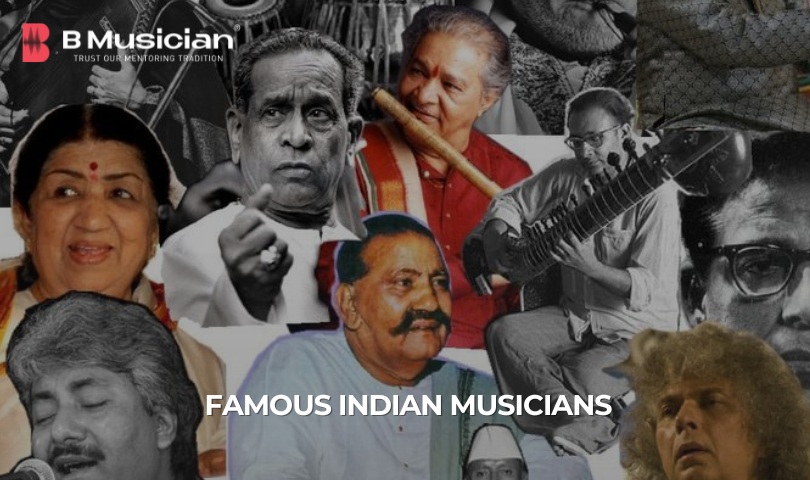
Indian music has always lived in a rare and beautiful paradox: it is ancient in spirit, yet endlessly evolving in form. For thousands of years, melodies and rhythms have carried stories, prayers, emotions, and identities across generations. But what makes Indian music extraordinary is how it continues to grow without ever abandoning its roots. Today, young learners discover ragas through apps, classical gurus teach on video calls, and global audiences sway to fusion that blends sitar with jazz or tabla with EDM. This remarkable journey of evolution did not happen overnight; it was shaped by visionary, Famous musicians of India, who refused to choose between the old and the new. They took the best of tradition and the power of modernity, and in doing so, created something timeless.
This blog explores the origins of Indian music, the shifts in learning methods, and the iconic artists who became bridges between eras. Their journeys show that tradition is not a limitation — it’s a foundation on which new worlds can be built.
Origins of Indian Music
The roots of Indian music stretch back to the Samaveda, one of the four ancient Vedic scriptures. The Vedic sages believed that sound was sacred and could connect humans to the divine. These early chants weren’t just recited — they were sung with specific tonal patterns, creating the earliest seeds of what would one day become Indian classical music.
As centuries passed, Indian music absorbed influences from geography, culture, and history. The country’s vastness allowed regional forms to flourish — folk songs in the villages, devotional bhajans in temples, qawwalis in shrines, ballads of tribal communities, and court music in royal households.
Over time, Indian classical music crystallised into two major systems: Hindustani Classical Music (North India)
Influenced by Persian, Central Asian, and Mughal aesthetics, Hindustani music grew into an improvisational, mood-driven tradition. Gharanas (lineages) developed distinct styles, and instruments like the sitar, sarod, and tabla became symbols of the form.
Carnatic Classical Music (South India)
Rooted in ancient Sanskrit and Tamil traditions, Carnatic music remained structurally rich, composition-oriented, and rhythmically intricate. With composers like Tyagaraja, Muthuswami Dikshitar, and Syama Sastri, this system created a vast ocean of kritis, varnams, and ragas.
Both traditions, despite their differences, shared a philosophy:
Music is not just performed; it is lived.
Types of Indian Music: A Rich, Layered Tapestry
Indian music is not a single stream — it is a confluence of many rivers:
- Classical Music (Hindustani & Carnatic): Deeply structured, emotion-filled, rooted in centuries of theory.
- Folk Music: Raw, powerful, and tied to communities and daily life—Rajasthani folk calls, Baul songs of Bengal, Lavani of Maharashtra, and more.
- Devotional Music: Bhajans, kirtans, qawwalis, abhangs—offering spiritual connection through melody.
- Light Classical & Semi-Classical: Thumri, ghazal, dadra—mixing classical discipline with expressive lyricism.
- Contemporary & Fusion: Bollywood, indie music, electronic fusion, global collaborations that take Indian sounds to new horizons.
This diversity is precisely why India needed artists with vision — people who could move across boundaries without losing authenticity.
Traditional Learning vs Modern Learning
For centuries, Indian music was preserved through the guru-shishya parampara — a sacred bond between teacher and disciple. Learning happened orally, through imitation, immersion, and years of close observation. This method created extraordinary musicians, but it also meant access was limited.
Traditional Learning: The Guru-Shishya Parampara
Pros:
- Immersive, holistic training
- Personalised guidance
- Deep emotional, spiritual connection to the art
- Strong grounding in purity and discipline
Cons:
- Requires years of dedication and physical presence
- Rigid structures that may limit experimentation
- Limited accessibility — many couldn’t find or afford a guru
- Slow pace not suited for modern learners
Modern Learning: Academies, Universities & Online music platforms
Pros:
- Accessible to anyone, anywhere
- Exposure to diverse styles and global influences
- Faster learning through structured courses
- Ability to replay lessons, use apps, record practice
Cons:
- Less emotional depth and mentorship
- Risk of superficial learning
- Over-dependence on technology
- Less emphasis on riyaz (rigorous practice)
Today, most students thrive in a hybrid model — a bit of tradition, a bit of technology, and a lot of passion. This approach owes much to the musicians who shaped the bridge between eras.
Famous Indian Musicians Who Bridged Tradition and Modernity Now let’s dive into the icons who reshaped the Indian musical landscape.
- Pandit Ravi Shankar — The Global Ambassador of Indian Classical Music
Pt. Ravi Shankar was the face of Indian music to the world. Trained traditionally under the legendary Allauddin Khan, he mastered the sitar through years of rigorous discipline. But what set him apart was his vision: he believed Indian classical music could sit proudly on the global stage.
His collaborations with George Harrison, Yehudi Menuhin, and Western orchestras introduced ragas to audiences who had never heard them. And yet, despite massive global fame, he never diluted the soul of classical music. His work made Indian music feel universal, and he opened countless doors for future musicians.
Contribution to learning:
He helped modernise teaching, produced instructional materials, and founded institutions where classical music could be learned structurally without losing depth.
- Ustad Zakir Hussain — A Tabla Genius Who Made the World Listen
If the tabla has become a global instrument, the credit goes largely to Ustad Zakir Hussain. Son of the legendary Ustad Alla Rakha, he inherited the best of traditional Punjab gharana training. But his artistic curiosity was boundless.
Jazz ensembles, world music bands, electronic fusion — Zakir Hussain explored everything. His collaborations with Shakti, Mickey Hart, and countless world artists set new standards in cross-cultural music.
Yet, every time he plays a solo, it carries the precision of centuries of heritage.
Contribution to learning:
He showed young learners that classical instruments can be cool, contemporary, and globally relevant — without sacrificing discipline.
- A.R. Rahman — The Sound of Modern India
A.R. Rahman is the bridge between generations in a way few musicians are. Trained in Carnatic music and skilled in Western classical orchestration, he brought spiritual depth into modern soundscapes.
Rahman’s music blends ragas with electronic layers, folk with symphonies, and Indian rhythms with global textures. Through his KM Music Conservatory, he introduced modern pedagogy while honoring traditional techniques.
Contribution to learning:
His school and global collaborations created a new blueprint for music education — one where classical training meets technology.
- Dr. L. Subramaniam — The Violin Virtuoso of Both Worlds
Dr. L. Subramaniam is one of the forces who transformed the violin into a global Carnatic ambassador. Classically trained from childhood, he mastered the exacting discipline of Carnatic techniques. But he also ventured boldly into jazz fusion, Western classical collaborations, and world music.
His ability to move seamlessly between Carnatic improvisations and orchestral compositions made him a pioneer.
Contribution to learning:
He showed how Western notation and Indian improvisation can coexist, giving students tools to navigate both worlds.
- Shankar Mahadevan — The Voice That Made Music Education Accessible
Shankar Mahadevan’s journey is a story of versatility. One moment he delivers a flawless Carnatic alapana; the next he belts out a Bollywood chart-topper or a folk-inspired melody. As part of Shankar-Ehsaan-Loy, he redefined contemporary Indian music.
But his greatest contribution may be the Shankar Mahadevan Academy, an online platform that brought structured Indian music lessons to thousands of students across the globe.
Contribution to learning:
He democratised music education, proving that passion and dedication matter more than geography.
- Anoushka Shankar — The New Voice of Global Indian Music
Carrying forward the legacy of Pt. Ravi Shankar, Anoushka Shankar represents a new generation. Trained rigorously in the classical tradition, she absorbed her father’s discipline. But her artistic identity goes beyond inheritance.
Anoushka blends sitar with flamenco, electronica, Western classical ensembles, and global folk traditions. Her music speaks not just of technique, but of emotion, identity, and social awareness.
Contribution to learning:
She has inspired young women worldwide to pursue classical instruments and opened conversations about individuality in classical learning.
- Pandit Hariprasad Chaurasia — The Flute Maestro Who Modernized a Traditional Instrument
Pt. Hariprasad Chaurasia transformed the humble bansuri into a symbol of Indian classical sophistication. His training came from both traditional gurus and his own relentless exploration.
He collaborated with Western orchestras, jazz musicians, and composers, proving that an ancient bamboo flute could travel across genres effortlessly.
Contribution to learning:
His Vrindavan Gurukul blended the traditional gurukul style with modern accessibility, offering students the best of both worlds.
How These Artists Transformed Music Learning
All these musicians did more than perform — they changed how students learn music today.
- They made Indian classical music global.
Suddenly, a student in Tokyo or Toronto could fall in love with ragas. 2. They embraced technology.
Online lessons, apps, digital recordings, global collaborations — all became normal. 3. They broke elitist barriers.
Music once reserved for a few became accessible to all.
- They encouraged experimentation.
Students now feel free to blend tradition with creativity.
- They built institutions.
Conservatories, academies, and global platforms continue to train new generations. Their journeys remind students that tradition is not a cage — it’s a set of wings.
Conclusion
Indian music stands today on a magnificent bridge built by visionary artists — a bridge connecting centuries of tradition with the possibilities of the modern world. These musicians did more than fuse genres; they fused mindsets. They showed us that honouring tradition doesn’t mean resisting change, and embracing modernity doesn’t mean forgetting where you come from.
For students learning music today, this era is a gift. Never before has it been so easy to access knowledge, explore styles, or connect with teachers worldwide. Yet, the essence remains the same: sincerity, practice, humility, and love for the art.
The future of Indian music will be shaped by those who, like the legends before them, dare to carry the past into the future — not as a burden, but as a beautiful inheritance ready to bloom in new forms. And in that journey, every learner becomes a bridge themselves, keeping the music alive, evolving, and inspiring.