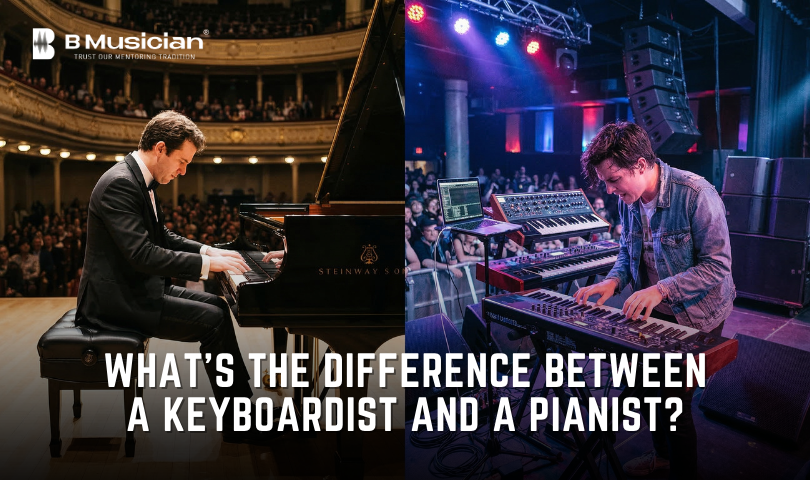
As a music educator and performing musician, one question I often hear from students and parents is this: Is a keyboardist the same as a pianist?
At first glance, the answer might seem obvious. Both instruments have black and white keys, and both musicians appear to play similar notes. But in reality, the difference between a keyboardist and a pianist goes far beyond the instrument itself.
Over the years, through my training, performing experience, and teaching, I have come to understand that piano and keyboard represent two different musical worlds. They overlap in many ways, but their approach to sound, training, performance, and creativity can be quite different.
Understanding the keyboard vs piano difference can help students choose the right instrument, help musicians grow more versatile, and help listeners appreciate these musicians more deeply.
Let’s explore the real difference between a keyboardist and a pianist.
The Piano: An Instrument of Expression
To understand the difference between keyboard vs piano, we must first look at the nature of the piano itself.
The piano is a purely acoustic instrument. When a pianist presses a key, a small hammer inside the instrument strikes metal strings, producing sound naturally without electronic amplification.
This means every detail of a pianist’s touch matters.
A slight variation in pressure can change:
- Tone
- Volume
- Emotion
- Musical phrasing
Because of this sensitivity, piano playing requires a deep focus on technique and musical expression.
Pianists train extensively in areas such as:
- Finger independence
- Dynamic control
- Pedal technique
- Musical interpretation
- Sight reading
Classical pianists often spend years studying composers like Bach, Beethoven, Mozart, Chopin, and Debussy. Their goal is not simply to play notes but to interpret the music in a way that communicates emotion and meaning.
In this sense, the pianist becomes a storyteller using sound.
If you want to begin developing this expressive style yourself, you can start with our structured online piano lessons designed for all levels.
The Keyboard: A Modern Musical Powerhouse
When discussing keyboard vs piano, the keyboard introduces a completely different dimension.
A keyboard is an electronic instrument capable of producing a wide range of sounds. Unlike the piano, which produces a single acoustic tone, keyboards can imitate many instruments.
A keyboardist might switch between:
- Piano
- Strings
- Synth pads
- Organs
- Brass sounds
- Electronic textures
Modern keyboards can store hundreds or even thousands of sound patches. This flexibility makes keyboardists essential in many genres such as:
- Pop
- Rock
- Film music
- Electronic music
- Worship music
- Fusion and world music
In many modern bands, the keyboardist is responsible for creating the entire background atmosphere of the music.
To start developing the creative layering and modern band‑style techniques that keyboardists use today, you can begin learning through our Keyboard Classes Online.
Keyboardist vs Pianist: Differences in Training
Another important aspect of keyboardist vs pianist lies in how musicians are trained.
Pianist Training
Traditional piano education often follows a structured classical approach. Students learn:
- Scales and arpeggios
- Music theory
- Sheet music reading
- Classical repertoire
- Technical exercises
Many pianists also prepare for graded exams such as Trinity or ABRSM, which focus heavily on precision, technique, and musical interpretation.
The training is disciplined and methodical.
A pianist spends years refining the smallest details of musical expression.
Keyboardist Training
Keyboardists often follow a more practical and contemporary learning path.
Instead of focusing mainly on classical repertoire, keyboard players usually develop skills such as:
- Chord progressions
- Improvisation
- Playing by ear
- Band accompaniment
- Sound programming
- Music production
Keyboardists also become comfortable working with technology, MIDI systems, and digital audio workstations.
In many ways, the keyboardist is both a performer and a sonic designer.
The Role of Pianists and Keyboardists in Music
Another key difference between keyboardist vs pianist appears in their roles during performance.
Pianists as Solo Performers
Pianists often perform solo recitals or classical concerts.
In these performances, the pianist is usually the central musical voice. The audience focuses entirely on the interpretation of the piece.
This type of performance requires:
- Deep emotional understanding
- Precise technique
- Strong stage presence
Every note carries significance.
Keyboardists in Bands and Ensembles
Keyboardists often work within bands or music groups.
Their job is to support the entire musical arrangement by adding layers of sound. For example, a keyboardist may simultaneously provide:
- Piano chords
- String sections
- Synth pads
- Bass layers
- Background textures
In many modern music performances, the keyboardist essentially becomes a one-person orchestra.
Technology: Where Keyboardists Shine
Technology is one of the biggest factors separating keyboard vs piano musicians. Keyboards often include advanced features such as:
- MIDI connectivity
- Sound layering
- Sampling
- Sequencers
- Arpeggiators
- Integration with music production software
Because of this, many keyboardists naturally transition into roles such as:
- Music producers
- Film composers
- Sound designers
- Arrangers
The keyboard becomes a central tool for modern music creation.
Technique Differences Between Piano and Keyboard
Although both instruments use similar layouts, the playing technique can differ.
Pianist Technique
Pianists develop a highly refined sense of touch.
They must control dynamics carefully because the instrument responds directly to physical pressure.
Pedal usage also plays a critical role in shaping sound and sustaining notes.
Keyboardist Technique
Keyboardists often focus more on:
- Chord voicings
- Groove and rhythm
- Sound layering
- Performance control
Because many keyboards have consistent velocity responses, the emphasis shifts slightly from acoustic tone shaping to arrangement and texture building.
Can a Musician Be Both a Keyboardist and a Pianist?
The simple answer is yes.
In fact, many musicians today benefit from learning both instruments.
Classical piano training builds strong technical foundations that can help keyboardists play with greater musical sensitivity.
At the same time, keyboard skills allow pianists to explore modern genres, technology, and music production.
From my experience as a musician and educator, the most versatile artists today are those who understand both piano and keyboard worlds.
They combine traditional musicianship with modern creativity.
Piano vs Keyboard: Which Should Beginners Learn?
Students often ask whether they should start with a piano or a keyboard. The answer depends on their musical goals.
If someone wants to pursue:
- Classical music
- Professional piano performance
- Music examinations
Then learning piano is usually the better choice.
However, if someone is interested in:
- Playing in bands
- Film music
- Music production
- Contemporary styles
Then learning the keyboard might be the more practical option.
Ideally, students should develop a strong musical foundation that allows them to explore both instruments.
Final Thoughts on Keyboardist vs Pianist
When discussing keyboard vs piano, it is important to remember that these instruments represent two different musical traditions.
A pianist focuses on acoustic expression, technique, and interpretation of music. A keyboardist explores sound design, technology, and musical versatility. Both require dedication, creativity and deep musical understanding.
Rather than viewing them as competing paths, we should see them as complementary worlds within the larger universe of music.
Because whether the sound comes from vibrating piano strings or digital synthesizers, the ultimate goal remains the same to create music that moves people.