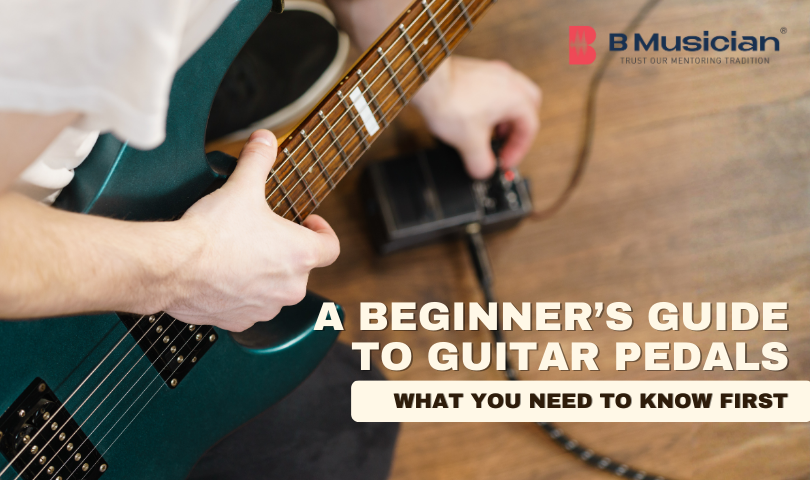
If you’ve ever wondered how your favorite guitarists create those incredible tones from soaring leads to crunchy rhythms the answer often lies in guitar pedals. These small devices sit between your guitar and amplifier, transforming your sound in countless creative ways. For beginners, entering the world of guitar effects pedals can feel overwhelming, but understanding the basics opens up exciting possibilities for your playing.
This blog covers everything you need to know before buying your first pedal, including essential effect types, how to connect them, and tips for building your first guitar pedal board.
What Are Guitar Pedals and How Do They Work?
Guitar pedals are electronic devices that modify your guitar’s signal before it reaches your amplifier. You activate them by pressing a footswitch, hence the name “stomp box.” Each pedal adds a specific effect to your tone, whether that’s distortion, echo, or atmospheric ambience.
The basic setup is simple: your guitar plugs into the pedal’s input, and the pedal’s output connects to your amp. When engaged, your signal passes through its circuitry and gets transformed. When bypassed, your clean guitar signal passes through unchanged. Multiple guitar effects pedals can be connected in sequence to create layered, complex tones that define your unique sound.
Essential Guitar Effects Pedals for Beginners
While hundreds of pedal varieties exist, most fall into a few core categories. Here are the essential types every beginner should understand.
Tuner Pedal
A tuner should be your first purchase. It ensures your guitar stays in tune during practice and performance, providing more accuracy than clip-on tuners. Most guitarists place the tuner first in their signal chain to read the cleanest possible signal from the guitar. Many tuners also double as a mute switch for silent tuning between songs.
Overdrive and Distortion
These guitar effects pedals add grit and sustain to your tone. Overdrive produces warm, smooth breakup similar to a cranked tube amp perfect for blues and classic rock. Distortion delivers heavier, more aggressive tones suited for hard rock and metal. Most guitarists consider one of these essential for playing rock music, as they form the foundation of countless iconic guitar sounds.
Delay
Delay pedals create echoes of your playing, repeating notes after a set time interval. Short delays add depth and dimension to your sound, while longer settings create atmospheric, ambient effects. This versatile effect appears in nearly every genre and remains a favorite among beginners for its immediate impact on tone.
Reverb
Reverb simulates the natural reflections of sound in physical spaces from small rooms to massive cathedrals. It adds life and dimension to your guitar tone, making it sound less dry and isolated. Many amps include built-in reverb, but a dedicated pedal offers more control and variety.
Modulation Effects
This category includes chorus, phaser, flanger, and tremolo. These effects add movement and texture by manipulating pitch, timing, or volume in subtle ways. Chorus creates a shimmering, doubled effect popular in clean tones, while phasers produce sweeping, psychedelic sounds heard throughout classic rock.
Building Your First Guitar Pedal Board
A guitar pedal board organizes your effects in one place, making them easy to transport and use during practice or performance. You don’t need an elaborate setup to start, even two or three pedals benefit from proper organization.
Start with a simple board that accommodates your current pedals plus room for future growth. Velcro strips secure pedals while allowing easy rearrangement as your collection expands. A quality power supply that powers multiple pedals eliminates the hassle of individual batteries and reduces unwanted noise in your signal.
You’ll also need patch cables short cables connecting each pedal to the next. Quality cables prevent signal loss and noise. Count your pedals and purchase one more cable than the total number (three pedals require four cables).
Understanding Signal Chain Order
The order of pedals on your guitar pedal board significantly affects your overall tone. While experimentation is encouraged, this standard sequence works well for most players.
Start with your tuner, followed by filter effects like wah pedals. Gain pedals overdrive, distortion, and fuzz come next. Modulation effects follow the gain section. Finally, time-based effects like delay and reverb go at the end. This order ensures each effect processes the cleanest, most appropriate signal for optimal results.
Common Mistakes Beginners Make with Guitar Pedals
Many beginners rush into using guitar pedals without building proper foundations first. Understanding these common mistakes helps you avoid frustration and progress faster in your musical journey.
The biggest mistake is using effects to mask poor technique. Distortion and reverb can hide sloppy playing temporarily, but bad habits become harder to fix over time. This is why online guitar lessons emphasize developing clean tone and solid technique before adding effects. A skilled instructor helps you build fundamentals that make your pedals sound better.
Another common error is using too many effects at once. Stacking multiple pedals without understanding each one creates muddy, undefined tones. Start with one pedal, learn its full range of sounds, then gradually add more. Online guitar classes teach you how to use effects musically knowing when to engage a pedal matters as much as owning one.
Finally, beginners often set effect levels too high. Subtlety usually sounds more professional than extreme settings. A touch of reverb adds polish; too much creates a washed-out mess. Learning restraint through structured practice and guidance from online guitar lessons helps you develop the musical taste that separates amateur sounds from professional tones.
Take Your Guitar Playing Further
Understanding guitar pedals is just one aspect of becoming a well-rounded guitarist. While effects enhance your sound, solid technique and musical knowledge form the foundation of great playing.
Ready to develop your guitar skills with expert guidance? Explore BMusician’s online guitar classes and learn from experienced instructors who can help you master technique, music theory, and practical playing skills. Our structured courses cover everything from beginner fundamentals to advanced concepts.
Frequently Asked Questions
What guitar pedal should I buy first?
A tuner pedal should be your first purchase for practical reasons. For your first effect pedal, choose based on your musical interests—overdrive for rock and blues players, or delay if you want versatile ambient sounds.
Do I need a pedalboard right away?
Not immediately. With one or two pedals, you can simply place them on the floor. Once you have three or more guitar effects pedals, a guitar pedal board helps with organization, transportation, and power management.
Can I use guitar pedals with any amplifier?
Yes, guitar pedals work with virtually any amplifier. However, some effects sound better with certain amp types. Clean amps let pedals shine, while already-distorted amps may clash with overdrive pedals.
Should I learn guitar basics before using pedals?
Yes, building solid technique first ensures you get the most from your effects. Online guitar lessons help you develop proper fundamentals so your pedals enhance good playing rather than hiding weaknesses.