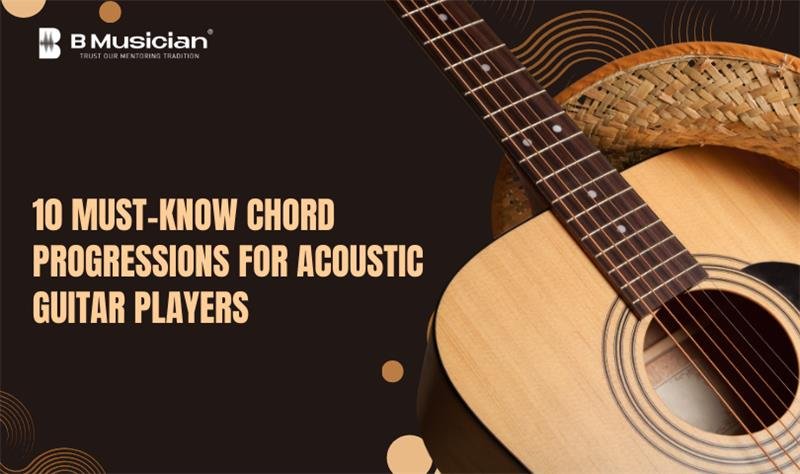
If you’ve ever sat down with an acoustic guitar and wondered why some songs just feel right under your fingers, the answer is almost always in the chord progressions. The way chords move from one to the next creates emotion, tension, and resolution and once you understand these patterns, you’ll start hearing them everywhere.
Whether you’re a complete beginner working through your first online guitar lessons or an intermediate player looking to expand your musical vocabulary, mastering a set of core chord progressions will transform how you write, play, and even sing along to your favorite songs. And yes, if you’ve been exploring singing lessons online alongside your guitar practice, knowing these progressions will make it significantly easier to find your vocal melody over any chord arrangement.
Let’s break down the 10 most essential chord progressions every acoustic guitar player should have in their toolkit.
Why Chord Progressions Matter
Before diving in, it helps to understand what makes a chord progression work:
- Chords are built from scales, and within any given key, certain chords have a natural gravitational pull toward one another
- When composers and songwriters tap into these relationships, they create music that feels emotionally satisfying, whether melancholy, uplifting, tense, or resolved
- Understanding chord progressions helps you recognize patterns across genres including folk, pop, blues, and country
- The progressions below range from easy chord progressions all the way to beautiful chord progressions that will genuinely surprise your audience
1. The I–IV–V (The Foundation of Everything)
The I–IV–V is the backbone of Western music and the first chord progression every guitarist should learn. Its three chords cover the most important harmonic pillars of any major key, making it incredibly versatile across nearly every genre.
Example in G major: G – C – D
- One of the most fundamental chord progressions, appearing in thousands of songs across blues, country, folk, rock, and pop
- The I, IV, and V chords naturally complement each other based on their relationship within the major scale
- In G major, that’s G (I), C (IV), and D (V) — strum through them and you’ll immediately recognize the sound
- Widely considered one of the most reliable basic chord progressions in existence
- Perfect starting point for beginners before moving on to more complex patterns
2. The I–V–vi–IV (The Pop Giant)
This chord progression is the engine behind an enormous number of hit songs. Its blend of major brightness and minor emotion gives it a universal appeal that works in virtually any musical setting.
Example in C major: C – G – Am – F
- One of the most widely used chord progressions, powering countless chart-topping songs across modern pop, rock, and indie
- The shift from the major I and V chords to the minor vi adds emotional depth that keeps listeners engaged
- Works beautifully on acoustic guitar with open chords — try fingerpicking it slowly to bring out its lyrical quality
- A go-to choice for singer-songwriters because it supports both strummed and melodic vocal deliveries
- Instantly recognizable to most listeners, making it ideal for covers and originals alike
3. The I–vi–IV–V (The ’50s Progression)
Rooted in the golden era of early rock and roll, this chord progression carries a nostalgic, feel-good energy. Its circular nature makes it easy to loop and incredibly satisfying to play.
Example in G major: G – Em – C – D
- A staple chord progression found in doo-wop, early rock and roll, and modern indie pop
- The movement from I to vi introduces a touch of wistfulness before the IV and V bring it back around
- Smooth, circular, and deeply familiar to most ears
- One of those simple chord progressions that sounds more sophisticated than it actually is to play
- A huge win for developing guitarists who want to impress without overcomplicating things
4. The vi–IV–I–V (Minor Start Variation)
By simply reordering familiar chords to begin on the minor vi, this chord progression takes on a completely different emotional character, more reflective, cinematic, and deeply expressive.
Example in A minor: Am – F – C – G
- Uses the same chord set as progression #2 but starting on the vi (minor) chord, which completely shifts the emotional feel
- Beginning on the minor chord creates an immediately more introspective and melancholic opening
- One of the most expressive minor chord progressions widely used in emotionally charged ballads and cinematic acoustic pieces
- Demonstrates how chord order not just chord choice shapes the overall mood of a song
- Often featured in acoustic guitar lessons as an early example of how arrangement affects emotion
5. The ii–V–I (The Jazz Borrowing)
Lifted from jazz harmony, this chord progression brings a sophisticated sense of tension and resolution that elevates any acoustic guitar performance beyond the everyday.
Example in C major: Dm – G – C
- A chord progression borrowed from jazz and bossa nova, delivering one of the most harmonically satisfying movements you can learn
- The ii chord creates gentle tension that the V resolves beautifully into the I
- Works especially well in fingerstyle arrangements on acoustic guitar
- Ideal for players who want to move beyond purely strummed folk and pop into something with more harmonic sophistication
- Adds a sense of musical maturity to any acoustic performance or composition
6. The I–IV–vi–V (The Emotional Pivot)
This chord progression is built for storytelling. The unexpected drop to the minor vi creates an emotional turning point that gives songs a compelling sense of narrative movement.
Example in D major: D – G – Bm – A
- A chord progression that introduces the minor vi after the familiar I–IV, creating an unexpected emotional dip before the V chord drives it forward
- Has a strong storytelling quality — a sense of things going well, then encountering a complication, then pushing through
- A favorite among singer-songwriters for its natural melodic space
- If you’ve been pairing your guitar practice with singing lessons online, this progression gives your vocal line plenty of room to move, sigh, or soar
- Pairs equally well with strumming patterns and more delicate fingerpicking styles
7. The i–VII–VI–VII (Natural Minor Loop)
Dark, hypnotic, and endlessly repeatable, this chord progression thrives in minor territory. Its looping quality makes it perfect for building atmosphere and intensity in acoustic arrangements.
Example in A minor: Am – G – F – G
- One of the most atmospheric and hypnotic minor chord progressions you’ll come across
- The back-and-forth between VI and VII keeps the ear slightly off-balance in a compelling, unresolved way
- Frequently heard in folk rock, indie, and alternative acoustic music
- Works brilliantly with both strumming and fingerpicking patterns
- One of the more interesting chord progressions to experiment with rhythmically try different tempos and feels to explore its full range
8. The i–VI–III–VII (The Epic Minor)
Few chord progressions carry the cinematic weight of this one. Its sweeping minor movement creates a sense of scale and drama that works beautifully on a steel-string acoustic guitar.
Example in A minor: Am – F – C – G
- A powerful chord progression with a sweeping, cinematic quality — one of the most dramatic minor movements in acoustic guitar playing
- Creates a sense of scale, making it perfect for songs with big emotional themes or anthemic choruses
- Letting each chord ring cleanly before transitioning gives this progression its full emotional weight
- Particularly effective when played with a capo higher up the neck, where the tone becomes brighter and more cutting
- A popular choice for acoustic covers of epic or emotionally intense songs
9. The I–III–IV (The Three-Chord Surprise)
The use of a major III chord makes this chord progression stand out immediately. It has a soulful, gospel-tinged brightness that lifts the emotional energy of any song in a distinctly memorable way.
Example in G major: G – B – C
- A chord progression that uses a major III chord (B major in G) instead of the more common minor iii, creating a striking and unexpected brightness
- Frequently used in gospel, blues-influenced rock, and soulful acoustic writing
- One of those guitar chord progressions that sounds slightly unusual on paper but feels completely natural once played
- The raised third dramatically lifts the emotional register of any song
- A great way to add an unexpected twist to progressions that might otherwise feel predictable
10. The I–V–vi–iii–IV (The Extended Loop)
Adding the iii chord to the classic four-chord loop gives this chord progression an extra layer of harmonic richness. It flows with a gentle, organic quality that sounds effortlessly musical even at slow tempos.
Example in C major: C – G – Am – Em – F
- A five-chord chord progression that adds the iii chord (Em in C major) to the familiar I–V–vi–IV sequence, giving it extra movement and sophistication
- One of the most beautiful chord progressions in the common Western harmonic vocabulary — gentle, flowing, and emotionally layered
- Played fingerstyle on an acoustic, it almost sounds like a complete piece of music on its own
- A wonderful progression to practice if you want to develop both chord transitions and right-hand technique simultaneously
- Rewards patience — the more smoothly you can move through all five chords, the more impressive the result
How to Practice These Chord Progressions Effectively
Knowing the chord progressions is only half the work — internalizing them is where the real learning happens. Here’s how to get the most out of your practice sessions:
- Practice each chord progression in multiple keys — Start with open chord-friendly keys like G, C, D, and A, then challenge yourself with Bb or Eb using a capo
- Alternate between strumming and fingerpicking — The same progression reveals completely different musical personalities depending on your right-hand technique
- Loop progressions and improvise over the top — Whether you’re working on lead guitar lines or vocal melodies, playing over a looped chord progression is one of the best ear-training exercises available
- Record yourself — Even a simple voice memo lets you hear your timing, dynamics, and transitions in a way that’s hard to notice while playing
- Follow a structured curriculum — Exploring dedicated online guitar lessons connects these chord progressions to real songs, music theory, and technique in a logical sequence. You can find a comprehensive course library at BMusician’s Acoustic Guitar Lessons
Connecting Chord Progressions to Your Voice
For players who also sing or who want to start chord progressions are the bridge between your instrument and your voice:
- Understanding which chord progressions naturally support melodic movement gives you a huge advantage when writing or performing
- Knowing where tension points fall and how the harmony breathes informs your pitch choices and phrasing
- Harmonic awareness developed through guitar study directly strengthens your overall musical confidence as a vocalist
- Many musicians pursue both guitar instruction and vocal training in tandem — the two disciplines reinforce each other at every level
Conclusion
Mastering these 10 chord progressions is one of the most impactful steps you can take as an acoustic guitar player. Whether you’re just picking up the instrument for the first time or returning after a break, these progressions give you a solid harmonic foundation to build on. They appear in virtually every genre you love — from folk and country to pop and blues and once they’re under your fingers, you’ll never run out of musical ideas.
Start with the progressions that feel most comfortable, gradually work your way through the more complex minor and extended patterns, and always practice them in different keys and styles to fully internalize how they sound and feel. The journey from your first open G chord to a fully realized fingerstyle arrangement is one of the most rewarding in music and understanding chord progressions is where that journey truly begins.
Frequently Asked Questions
A chord progression is a sequence of chords played in a specific order to create harmony, emotion, and musical structure in a song. For guitar players, understanding chord progressions is essential because they form the foundation of virtually every song you'll ever play or write. Rather than learning songs one at a time, knowing the most common chord progressions allows you to recognize patterns across hundreds of songs instantly making it easier to learn new music, improvise, and compose your own. Whether you're a beginner or an advancing player, chord progressions are the single most important harmonic concept to master on the acoustic guitar.
The most widely used chord progression in popular music is the I–V–vi–IV. In the key of C major, that's C – G – Am – F. This progression appears in an enormous number of hit songs across pop, rock, country, and indie genres because it balances major brightness with minor emotion in a way that feels both familiar and satisfying to listeners. If you only learn one chord progression as a beginner, this is the one to start with — it's instantly recognizable and works equally well with strumming or fingerpicking on an acoustic guitar.
Major chord progressions are built around major chords and generally produce a bright, uplifting, or happy sound — for example, the I–IV–V progression in G major (G – C – D). Minor chord progressions, on the other hand, are rooted in minor chords and tend to create a darker, more melancholic, or emotionally intense atmosphere — such as the i–VII–VI–VII progression in A minor (Am – G – F – G). The key difference lies not just in the individual chords but in the overall emotional feel they produce together. As an acoustic guitar player, learning both major and minor chord progressions gives you the full emotional range needed to play across any genre or mood.
The time it takes to learn chord progressions depends on your current skill level and how consistently you practice. Most beginners can learn a basic three or four chord progression — like the I–IV–V or I–V–vi–IV — within a few weeks of regular practice. The real goal, however, isn't just memorizing the chords but internalizing how they sound and feel so you can move between them fluidly and recognize them by ear. Practicing each progression in multiple keys, alternating between strumming and fingerpicking, and following structured online guitar lessons or acoustic guitar lessons can significantly speed up this process and help the patterns become second nature.
Absolutely. Chord progressions and vocal performance are deeply connected. When you understand the harmonic movement of a progression — where the tension builds, where it resolves, and how each chord shift feels — you develop a natural instinct for phrasing your vocal melodies more expressively. Singers who also play guitar and understand chord progressions tend to have stronger pitch accuracy, better musical phrasing, and a more developed ear overall. If you're pursuing singing lessons online alongside your guitar practice, working with these progressions will give your voice a harmonic context to work within, making your singing more confident, controlled, and musical.